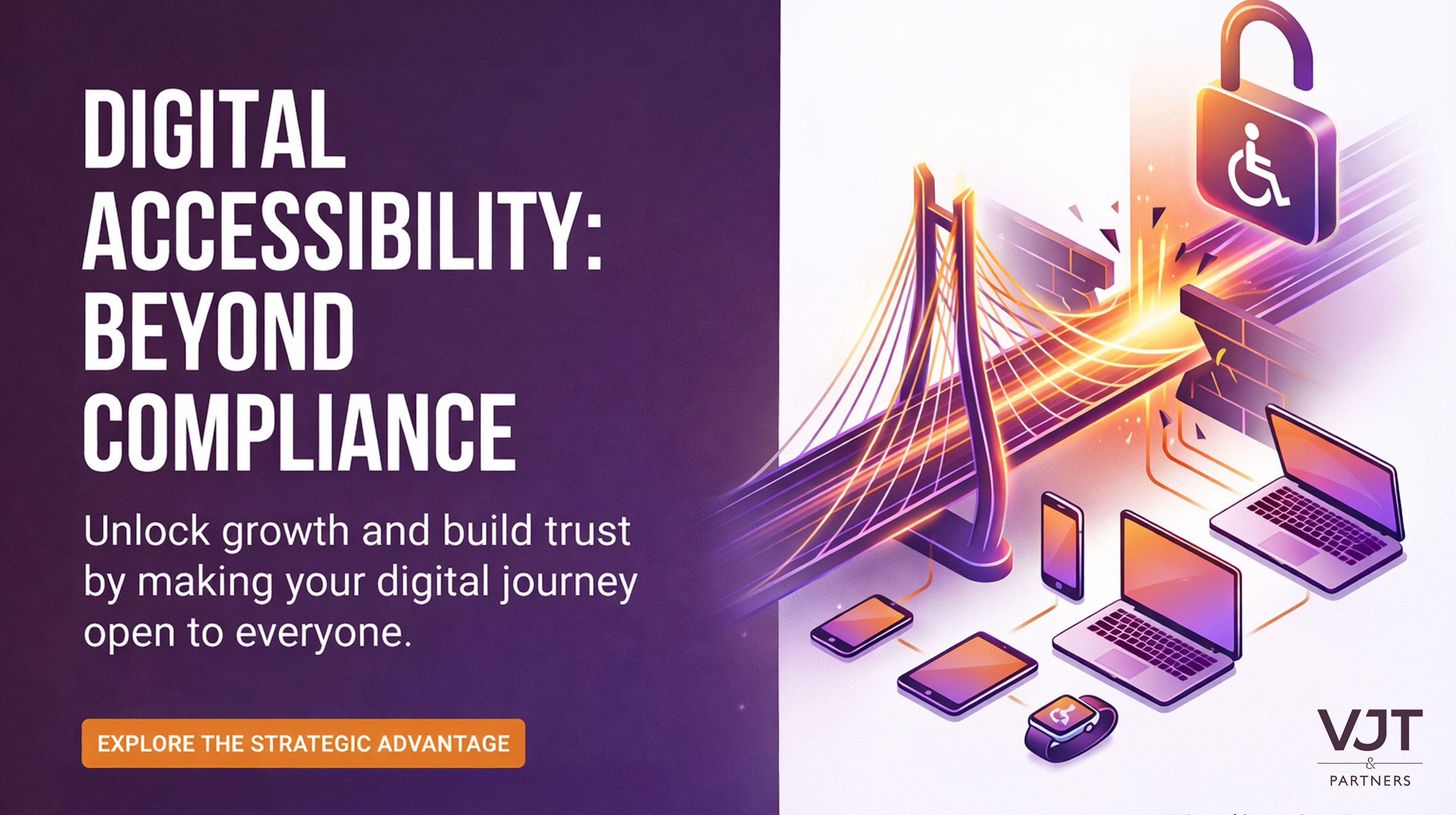
Hungary’s implementation of the European Accessibility Act (EAA) marks one of the most significant regulatory developments for businesses offering digital products and services. With Act XVII of 2022 and its implementing decree now fully in force, accessibility has become a cross-sector compliance obligation that companies operating in Hungary can no longer postpone. The national framework follows the EU directive, but introduces some local nuances that organisations must understand.
At its core, the EAA requires that digital content, services and the digital components of physical products be accessible to persons with disabilities. This obligation extends well beyond the familiar concept of “website accessibility.” In Hungary, it applies to a wide range of industries — from e-commerce and consumer electronics to financial services, transport, media, publishing, and any business that provides user-facing digital interfaces, online documentation or software-supported interactions.
In practical terms, accessibility means that information and digital processes must be perceivable and operable in multiple ways. Visually impaired users may rely on high contrast or enlarged text; blind users depend on structured content compatible with screen readers; users with limited mobility must be able to navigate interfaces using a specialized keyboard. Hungarian law reflects these principles by requiring that a single digital journey can be performed through alternative equivalent means, irrespective whether the interface is a website, mobile app, product UI or digital support environment.
Ensuring compliance is inherently multidisciplinary. It requires legal interpretation, UX and service design, software development, testing, internal documentation and the preparation of accessibility statements or burden assessments. Companies are increasingly recognising that compliance is not limited to their homepage or mobile app, but extends for example to digital manuals, booking flows, error messages, customer support interfaces, downloadable documents or any software-driven customer interaction.
Although the EAA’s rules are harmonised across the EU, Hungary’s supervisory approach reflects its sector-based regulatory landscape, where different bodies oversee different types of services. As a result, organisations must be prepared for sector-specific oversight.
Since the EAA became enforceable in June 2025, Hungarian regulators are in the early enforcement phase. While no high-profile cases have yet been published, companies are increasingly updating their digital platforms and issuing accessibility statements in anticipation of more structured oversight. The timing is significant, as a revised version of the harmonised standard EN 301 549 (v4.1.1) is currently under development, with publication targeted for 2026. Once finalised, it is expected to refine the technical benchmarks that underpin accessibility compliance.
Hungarian law also makes clear that businesses cannot simply claim that accessibility would be too costly or would fundamentally alter their product: any such exemption must be documented in writing.
Combined with these strict justification requirements and Hungary’s high maximum penalty thresholds (which may reach up to 5% of annual turnover) the message to the market is clear: enforcement may not yet be highly visible, but the consequences of non-compliance are becoming increasingly significant.
Ultimately, accessibility is not just a regulatory obligation. It enhances user experience, expands the potential customer base and strengthens trust at a time when inclusivity is increasingly expected. For companies operating in Hungary and the wider CEE region, early and sustained attention to accessibility offers not only legal certainty, but a genuine competitive advantage turning compliance into better design, better usability and better business outcomes.
For more details, contact our experts: Andrea Belényi (belenyia@vjt-partners.com) and Endre Várady (varadye@vjt-partners.com).